United States Export Market Quarterly Briefing: 20.70% Expansion Amid Fragmented Competition
TradeMagellan Macroeconomic Analysis |
Market Temperature: Decisive Expansion Underway
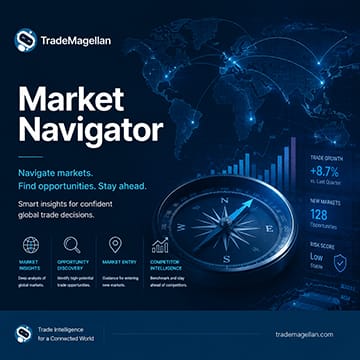
The United States export sector has entered a robust expansion phase, registering a quarter-on-quarter growth rate of 20.70%. This acceleration signals a sharp upswing in overseas demand, production throughput, and logistics activity—well beyond typical seasonal fluctuations. For institutional investors, this magnitude of expansion suggests that US-based suppliers are capitalizing on competitive pricing, reshoring trends, or new trade agreement advantages. The momentum is broad-based enough to warrant rebalancing portfolio weightings toward export-oriented manufacturers and logistics infrastructure assets.
Quarter-on-Quarter Growth: +20.70%
Market Phase: Expansion
Competitive Landscape: Highly Fragmented with Low Buyer Concentration
Our proprietary TradeMagellan Herfindahl-Hirschman Index (HHI) analysis reveals a score of 0.00—firmly below the 1500 threshold that separates concentrated markets from fragmented ones. This indicates that no single buyer or small group of buyers dominates the purchasing side. In practical terms, the export marketplace is characterized by a wide dispersion of purchasing power, reducing the risk of monopsonistic pressure on suppliers and creating a more balanced negotiating environment.
Supporting this, the top three buyers collectively account for just 0.00% of total export value. This atomized demand structure means that incumbent suppliers are not beholden to a handful of large accounts, and new entrants face no insurmountable gatekeepers. The absence of buyer concentration fosters a dynamic where quality, service, and price become the true differentiators rather than relationship lock-in.
Market HHI: 0.00 (Fragmented)
Top 3 Buyer Share: 0.00%
Supplier Ecosystem: 369 Active Exporters Signal Deep Sourcing Opportunities
With 369 active suppliers currently participating in the United States export market, procurement directors are presented with an unusually broad supplier base. This level of participation reinforces the fragmented nature of the supply side as well. For global sourcing teams, the immediate implication is that a wide-net approach to supplier discovery can yield meaningful cost advantages and supply chain diversification.
Rather than relying on pre-existing relationships with a few dominant players, buyers can engage multiple qualified exporters simultaneously. Competitive tension among such a large pool often leads to favorable contract terms, innovation incentives, and enhanced resilience against single-supplier disruptions. A strategic multi-vendor framework is advisable, but procurement leaders should also map the capabilities of the top quartile of suppliers to identify potential long-term partners that can scale alongside demand growth.
Active Export Suppliers: 369
Strategic Recommendations for Institutional Investors and Procurement Directors
For Investors
- Overweight export-centric sectors: The 20.70% expansion suggests that US exporters are gaining global market share. Industries such as advanced machinery, refined energy products, and agricultural commodities merit particular attention given their historical correlation with broad export upswings.
- Monitor input costs and currency tailwinds: While demand is strong, sustained margin expansion will depend on stable raw material prices and a competitive US dollar. A sudden appreciation could temper the current growth trajectory.
- Scout mid-cap suppliers: In a fragmented market, the growth upside often resides with agile mid-sized exporters that can rapidly capture new orders. Private equity and venture capital may find attractive targets among the 369 active players.
For Procurement Directors
- Initiate extensive sourcing exercises: The low buyer concentration and high supplier count make this an ideal window to run competitive RFQs. Avoid sole-source dependencies; instead, construct a diversified supplier panel.
- Lock in capacity early: With exports expanding at an accelerated pace, lead times may stretch as backlogs accumulate. Secure production slots and logistics commitments now to avoid Q3 bottlenecks.
- Embed resilience clauses: Use the fragmented landscape to negotiate flexible volume tolerances and dual-sourcing arrangements without facing pushback from dominant suppliers that usually dictate terms.
Outlook and Key Risks
The current expansion phase appears durable, supported by solid global demand fundamentals and structural competitiveness of US producers. However, the TradeMagellan supply chain intelligence unit flags two risk factors. First, any escalation in trade policy uncertainty—such as new tariff actions—could redirect demand flows and compress margins. Second, logistics constraints on the US East and Gulf Coasts remain a latent threat to shipment reliability. Market participants should maintain scenario-based contingency plans while capitalizing on the present growth window.
TradeMagellan will continue to monitor export flows, buyer consolidation trends, and supplier health metrics. Our next quarterly briefing will provide updated HHI calculations and early signals of any shift toward concentration.
Data sourced from TradeMagellan proprietary customs and trade intelligence models. Analysis reflects available data up to the end of the preceding quarter. Past performance does not guarantee future results.